
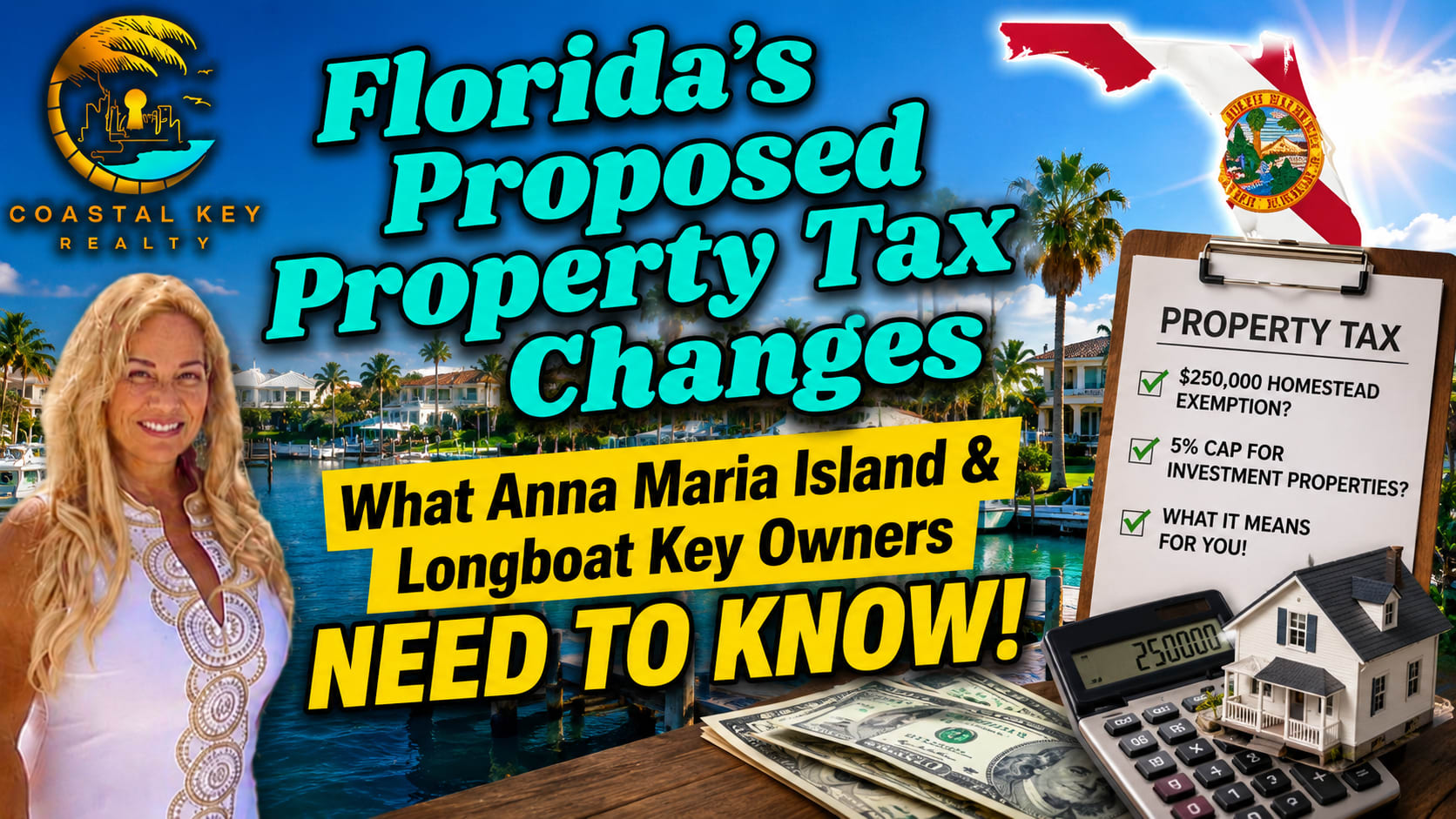

Florida homeowners may be looking at a major change to property taxes.
A proposal approved by the Florida Legislature would significantly increase the state's homestead exemption and reduce the annual assessment increase allowed on certain non-homestead properties.
For homeowners and buyers on Anna Maria Island and Longboat Key, there are two numbers to know:
$250,000 and 5%.
Here's the simple version.
First: The $250,000 Homestead Exemption
If you own a home that qualifies for Florida's homestead exemption, the proposal would eventually allow you to exempt $250,000 of your property's assessed value from non-school property taxes.
The exemption would be phased in:
- $150,000 beginning January 1, 2027
- $250,000 beginning January 1, 2028
The important detail is that this does not eliminate school property taxes. The proposal specifically excludes school district levies from the new $250,000 exemption.
What does that mean in real life?
Imagine you own a qualifying primary residence with an assessed value of $250,000.
If the amendment passes and you qualify for the full exemption, the first $250,000 of assessed value could be exempt from the applicable non-school property taxes.
That's why you've probably heard this proposal described as potentially eliminating most property taxes on lower-value homesteaded homes.
For a more expensive home, the benefit could still be significant because the first $250,000 would receive the exemption.
But There's an Important Catch for People Moving to Florida
If you're considering moving to Anna Maria Island or Longboat Key, don't assume you'll immediately receive the full $250,000 exemption.
The proposal creates different rules for people who establish Florida residency after January 1, 2027.
New Florida residents would initially receive a $50,000 exemption for non-school property taxes and would become eligible for the larger exemption after satisfying the proposal's residency requirements.
So if you're thinking about buying a Gulf Coast home and making Florida your permanent residence, when you establish Florida residency could matter.
Second: What About Investment Properties?
This is where things get particularly interesting for the Anna Maria Island and Longboat Key market.
A vacation rental, second home, or investment property generally does not qualify for the homestead exemption simply because you own it.
So an investor should not look at the proposal and think:
"I get a $250,000 tax exemption on my rental property."
That's not what the proposal says.
Instead, the important number for certain non-homestead properties is:
5%
The proposal would reduce the annual assessment-growth limitation for certain non-homestead real property from 10% to 5%, beginning January 1, 2027.
This could help slow the growth of your property-tax bill because your property's assessed value would be limited to a 5% annual increase rather than as much as 10%. For example, if a property's assessed value were $500,000, a 5% cap would limit the increase to $25,000 per year, rather than as much as $50,000 under a 10% cap.
But Buyers Need to Pay Attention
Here's one of the most important things to understand if you're purchasing an investment property:
You cannot necessarily look at the seller's current property-tax bill and assume yours will be the same.
The proposal allows property to be reassessed at just value following certain changes in ownership or control.
So if you're buying an investment property, you need to consider what the property's assessed value and taxes could look like after the purchase, rather than simply using the seller's current tax bill.
That's something we always recommend buyers examine carefully when evaluating an investment property.
So What Does This Mean for You?
It really comes down to what kind of property you're buying.
🏠 Buying a Primary Home?
The proposed $250,000 homestead exemption could be a significant benefit if you qualify.
🏖️ Buying a Vacation Home?
Don't assume the $250,000 exemption applies. Homestead is tied to qualifying primary residence.
💰 Buying an Investment or Vacation Rental?
The proposed 5% assessment-growth limitation could be the provision that's more relevant to you.
But you'll also want to understand how a purchase could affect the property's assessed value.
🌴 Already Own a Florida Homestead?
The proposed changes could potentially provide a substantial reduction in the portion of your property taxes subject to the new exemption.
The Bottom Line
If you're a homeowner, the big number is $250,000.
If you're an investor, the big number is 5%.
The proposed amendment could make owning a Florida home less expensive for qualifying homesteaded homeowners while also changing how certain non-homestead properties are assessed.
But this is important:
It is not law yet.
The Florida Legislature approved the proposed constitutional amendment, and it is scheduled to go before Florida voters in the November 2026 General Election. If approved, the changes would begin January 1, 2027.
So if you're considering buying a home or investment property on Anna Maria Island or Longboat Key, this is something worth watching.
Thinking About Buying on the Gulf Coast?
Whether you're looking for a primary residence, second home, condo, or investment property, property taxes are an important part of understanding the true cost of ownership.
Coastal Key Realty specializes in helping buyers and sellers navigate the Anna Maria Island and Longboat Key real estate markets.
If you're thinking about buying, selling, or investing, Amy Jones can help you evaluate the real estate side of the decision and connect you with the appropriate professionals for tax-specific questions.
📲 Call/Text: 941-993-9380
📧 Email: Amyjonesckr@gmail.com
🌐 Website: www.coastalkeyrealty.com
This article is for general informational purposes only and is not tax or legal advice. The proposed amendment has not yet taken effect. Consult a qualified tax professional regarding your individual situation.